


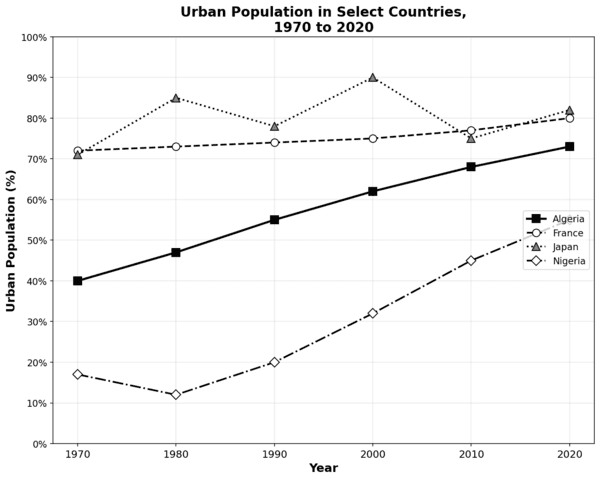
The share of the world’s population living in cities has increased dramatically since 1970, but this change has not been uniform. France and Japan, for example, were already heavily urbanized in 1970, with 70% or more of the population living in cities. The main contributors to the world’s urbanization since 1970 have been countries like Algeria, whose population went from _______
Which choice most effectively uses data from the graph to complete the assertion?
Explanation
Context: A line graph tracks the urban share of the population in Algeria, France, Japan, and Nigeria from 1970 to 2020. The passage says the main contributors to global urbanization since 1970 have been countries like Algeria, and the task is to finish that sentence with Algeria's figures.
Answer: D) around 40% urban in 1970 to more than 70% urban in 2020.
Why? The Algeria series starts at 40% in 1970 and climbs steadily to 73% by 2020. That fits the point being made: unlike France and Japan, already above 70% in 1970, Algeria did most of its urbanizing inside this window.
Traps:
- A) Algeria sits at 40% in 1970, not around 50%, and it ends near 73%, well short of 90%.
- B) 40% is the reading itself, so "less than 40%" understates it, and no country here approaches 90% in 2020.
- C) These are Nigeria's numbers, under 20% in 1970 and past 50% later, but the sentence has to describe Algeria.