


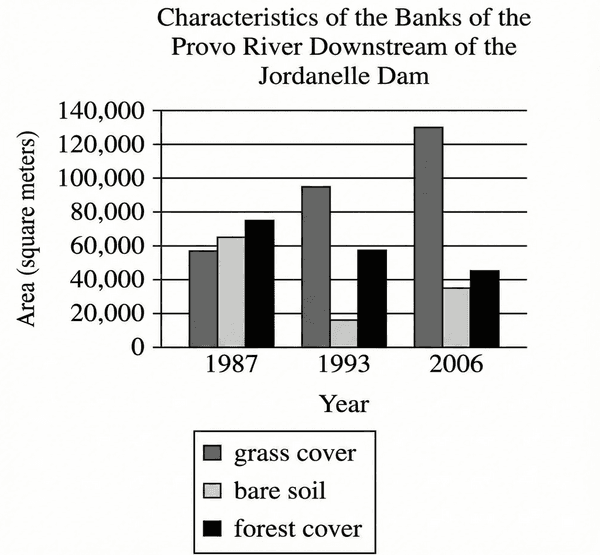
The Jordanelle Dam was built on the Provo River in Utah in 1992. Earth scientist Adriana E. Martinez and colleagues tracked changes to the environment on the banks of the river downstream of the dam, including how much grass and forest cover were present. They concluded that the dam changed the flow of the river in ways that benefited grass plants but didn’t benefit trees.
Which choice best describes data from the graph that support Martinez and colleagues’ conclusion?
Explanation
Context: A bar graph tracks grass cover, bare soil, and forest cover on the banks of the Provo River downstream of the Jordanelle Dam in 1987, 1993, and 2006. The team concluded the dam's flow changes benefited grass plants but not trees.
Answer: D) Grass cover increased from 1987 to 1993 and from 1993 to 2006, whereas forest cover decreased in those periods.
Why? Grass climbs from about 57,000 to about 95,000 to about 130,000 square meters while forest falls from about 75,000 to about 58,000 to about 45,000. Opposite trends across the same years are just what "helped grass, not trees" predicts.
Traps:
- A) One low grass value and one high forest value are static readings, and with no trend they cannot show the dam changing anything.
- B) Grass was below forest in 1987, about 57,000 against about 75,000, so the opening comparison is backwards.
- C) These bare-soil comparisons hold up numerically, but forest tops bare soil in all three years, which does not show trees losing ground.