


Hemerocallis sp. plants typically carry a negative electrical charge, while bees and other pollinators tend to accumulate a positive charge. Given that negatively and positively charged objects attract, a team hypothesized that the difference in charges could attract Hemerocallis sp. stamens to the plants’ pollinators. Based on the team's experiments, the hypothesis was well supported for positive charges above a certain threshold. The team found that foraging honeybees exceeded that threshold, which suggests that_____
Which choice most effectively uses data from the graph to complete the text?
Explanation
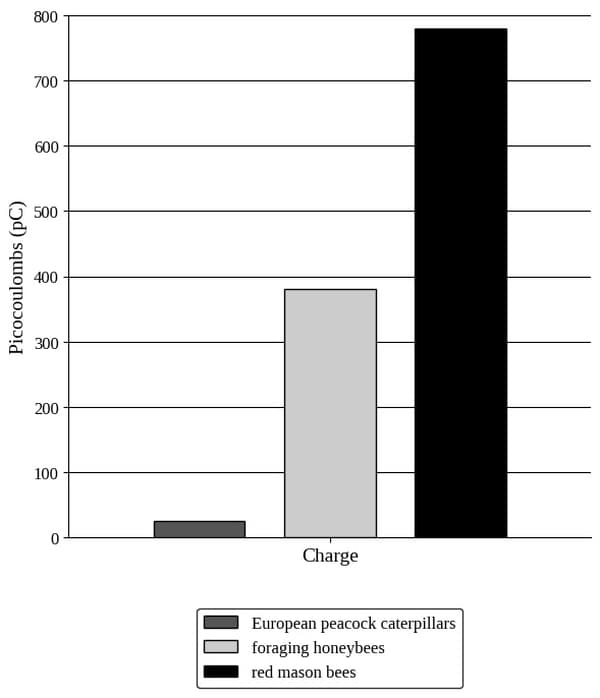
Context: Hemerocallis stamens carry a negative charge and pollinators pick up a positive one, so the team proposed that the charge difference could physically pull the stamens toward a visiting pollinator. Their experiments supported this — but only for positive charges above a certain threshold. The one anchor the passage gives us: foraging honeybees, at about 380 pC on the graph, clear that threshold. Graph values: European peacock caterpillars about 25 pC, foraging honeybees about 380 pC, red mason bees about 780 pC.
Answer: D) red mason bees can also attract the stamens.
Why? Red mason bees sit at about 780 pC — roughly double the honeybees' 380 pC. If 380 pC is already above the threshold, then 780 pC clears it comfortably as well. Same condition met, same conclusion: red mason bees can attract the stamens too.
Traps:
- A) the graph cannot pin down the threshold. All we know is that it sits somewhere below 380 pC, since honeybees exceed it. It could be 50, 100, or 300 — "greater than 100 pC" is never established
- B) wrong twice → caterpillars are at about 25 pC, far less than honeybees' 380, not greater; and a larger charge would make a pollinator more able to attract the stamens, not unable to
- C) caterpillars carry a positive charge and the stamens are negative — opposite charges attract, so nothing here repels. Whether 25 pC clears the threshold is unknown, but repulsion is ruled out either way