


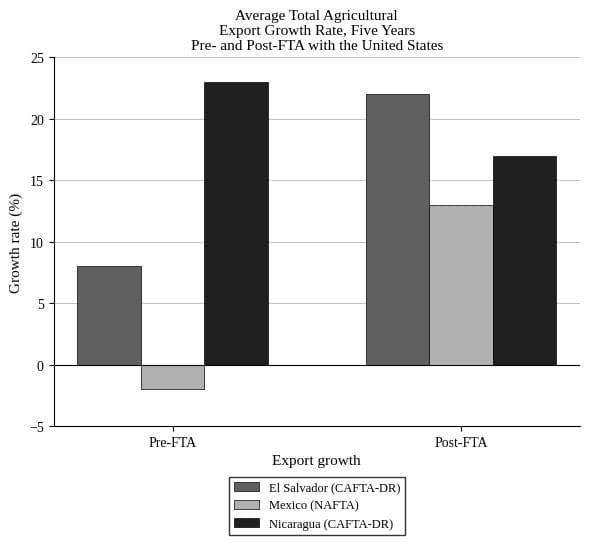
To measure whether countries in free trade agreements (FTAs)—agreements among nations to reduce tariffs, duties, and other trade barriers—experience changes in total agricultural exports, economist Kayode Ajewole and colleagues calculated average export growth rates for several countries over the five years before and the five years after entering an FTA with the United States. The graph shows the results for three countries in the study. Consulting the graph, a student claims that joining an FTA increases the rate of growth of a country’s total agricultural exports.
Which choice best describes data from the graph that weaken the student’s claim?
Explanation
Context: Ajewole's team compared average agricultural export growth in the five years before and after each country entered a free trade agreement with the United States, and a student claims that joining raises the growth rate. The graph gives pre- and post-FTA rates for El Salvador, Mexico and Nicaragua.
Answer: B) Although agricultural exports from Nicaragua grew over the five years after Nicaragua joined CAFTA-DR, their growth rate was even higher in the five years before CAFTA-DR.
Why? Nicaragua falls from about 23 percent growth before CAFTA-DR to about 17 percent after. Exports still rose, but more slowly, which is a direct counterexample to the claim that the agreement lifts the growth rate.
Traps:
- A) All three post-FTA rates are positive and they do vary, but variation among positive rates sits comfortably with the claim and names no country that lost ground.
- C) Mexico moves from about -2 percent to about 13 percent, the sharpest turnaround in the graph, so it supports the claim instead of weakening it.
- D) El Salvador's roughly 22 percent after joining does exceed its 8 percent before, another case that fits the student's generalization.