


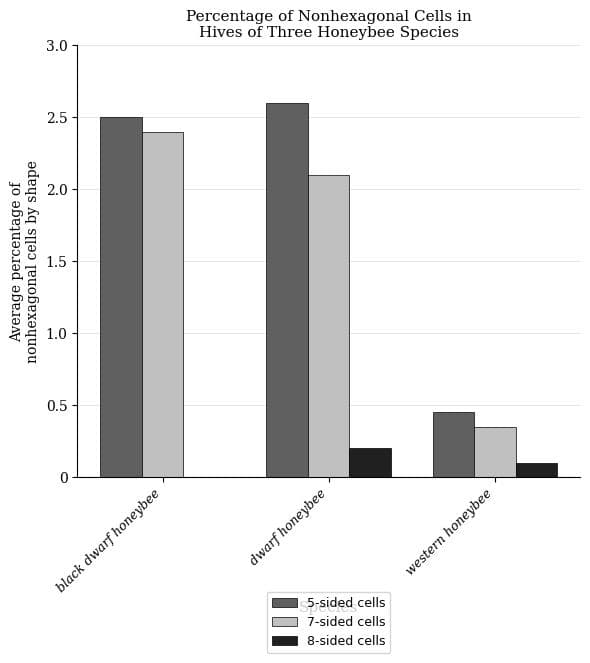
Honeybee hives consist mainly of hexagonal (six-sided) units called cells, in which queens lay eggs. Hexagonal cells for eggs that develop into nonreproductive workers are smaller than those for eggs that develop into reproductive drones, though the size difference varies by species. Difference in cell size results in a construction problem—it's hard to neatly connect sections of small cells to sections of large cells—that worsens as the difference increases. To fill in gaps between the sections when building a hive, bees rely on cells that have more or fewer than six sides. A student studying beehive structure consults data on three species, concluding that____
Which choice most effectively uses data from the graph to complete the student’s conclusion?
Explanation
Context: Bees fill the awkward joins between small worker cells and large drone cells with nonhexagonal cells, and the passage says the problem worsens as the size difference grows. The graph gives each species' average percentage of five-, seven-, and eight-sided cells.
Answer: A) Cells for worker eggs are probably closer in size to cells for drone eggs in the hives of the western honeybee than in the hives of the dwarf honeybee and the black dwarf honeybee.
Why? The western honeybee's bars total well under 1 percent (0.45, 0.35, and 0.1), against roughly 4.9 percent for each dwarf species. Needing the fewest patch cells points to the smallest gap between worker and drone cell sizes.
Traps:
- B) The graph plots cell shapes only and never says which eggs go in them, and the black dwarf honeybee has no eight-sided cells at all.
- C) The western honeybee's bar is the shortest for every shape, so it uses nonhexagonal shapes least, not most.
- D) Fewer nonhexagonal cells means a higher percentage of hexagonal cells for the western honeybee, and the margin is large, not slight.