


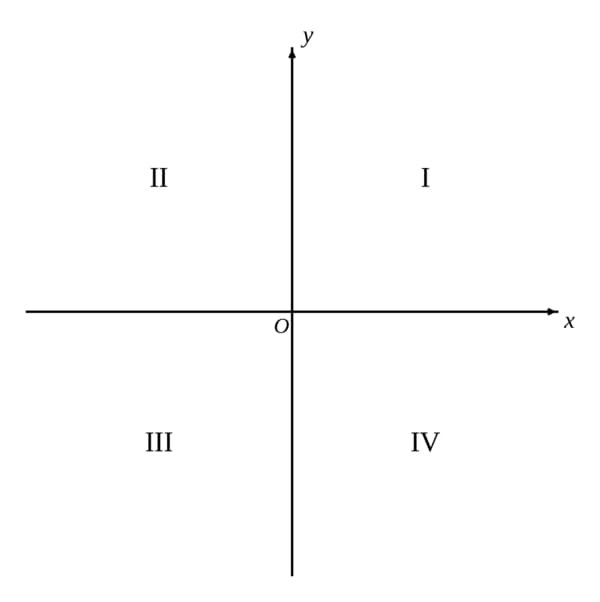
The figure shows the -plane with the quadrants labeled. The graph of a linear function (not shown), where , is a line completely contained in only quadrants I and II of the -plane. Which of the following could define the function ?
Explanation
Context: A linear function has a graph that lies completely inside quadrants I and II of the -plane, never entering III or IV. We need a rule that could define .
Answer: D)
Why? Quadrants I and II are the two regions above the -axis, so the line must stay above that axis for every . A line with any nonzero slope eventually crosses the -axis and drops into a lower quadrant, so the graph must be horizontal and positioned above the axis. That is exactly , a horizontal line units up.
Traps:
- A) has a positive slope, so for it falls below the -axis and enters quadrant III.
- B) is horizontal but sits below the -axis, lying entirely in quadrants III and IV.
- C) passes through the origin with positive slope, running through quadrants III and I.